If you run a business in Singapore, you’ve probably dealt with the same invoicing headache for years: PDF invoices sitting in an inbox, someone re-typing the numbers into accounting software, and a payment that takes weeks longer than it should. Multiply that across dozens or hundreds of invoices a month, and it’s easy to see why so many finance teams feel like they’re constantly playing catch-up.
This is exactly the problem InvoiceNow was built to solve.
InvoiceNow is Singapore’s nationwide e-invoicing initiative, developed to help businesses send and receive invoices directly between accounting systems — without PDFs, without manual re-entry, and without the delays that come with email-based invoicing. It’s already being adopted by thousands of companies, and with GST InvoiceNow reporting requirements being rolled out progressively by IRAS through 2031, more businesses will need to understand how it works in the years ahead.
In this guide, you’ll learn what InvoiceNow actually is, how it works behind the scenes, why it matters for Singapore businesses, the real benefits it offers, and how to choose the right InvoiceNow-ready software for your company. We’ll also look at how a platform like Adaptive BizApp fits into the picture once you’re ready to move forward.
InvoiceNow is Singapore’s national e-invoicing network, introduced by the Infocomm Media Development Authority (IMDA) to give businesses a standard, structured way to exchange invoices electronically.
Instead of creating an invoice, printing it or converting it to PDF, and emailing it to a customer, InvoiceNow allows the invoice data itself to travel directly from your accounting or ERP system into your customer’s system. The invoice arrives already in a structured digital format, ready to be processed — no retyping, no scanning, no chasing.
The easiest way to understand the difference is this: a PDF invoice is just a picture of information. Someone on the receiving end still has to read it and manually key it into their own system. An InvoiceNow invoice is actual structured data. It goes straight into the receiving system’s records, the same way a bank transfer moves money without anyone manually copying figures between banks.
InvoiceNow is built on Peppol, an international standard used by government agencies and businesses across Europe, Australia, New Zealand, and parts of Asia to exchange documents like invoices in a consistent format. Singapore adopted Peppol as the backbone of InvoiceNow so that local businesses could exchange invoices not just with each other, but eventually with trading partners overseas, using the same underlying network.
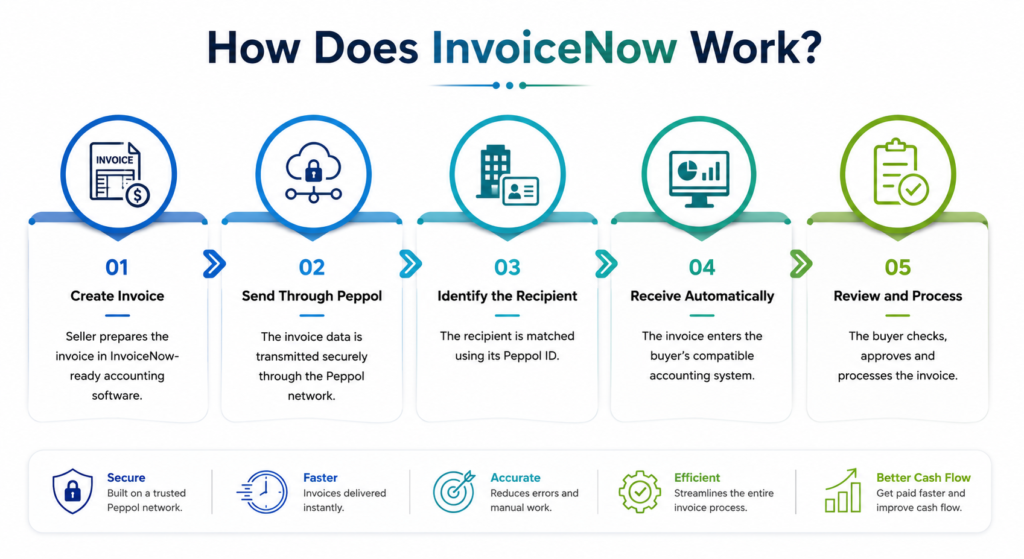
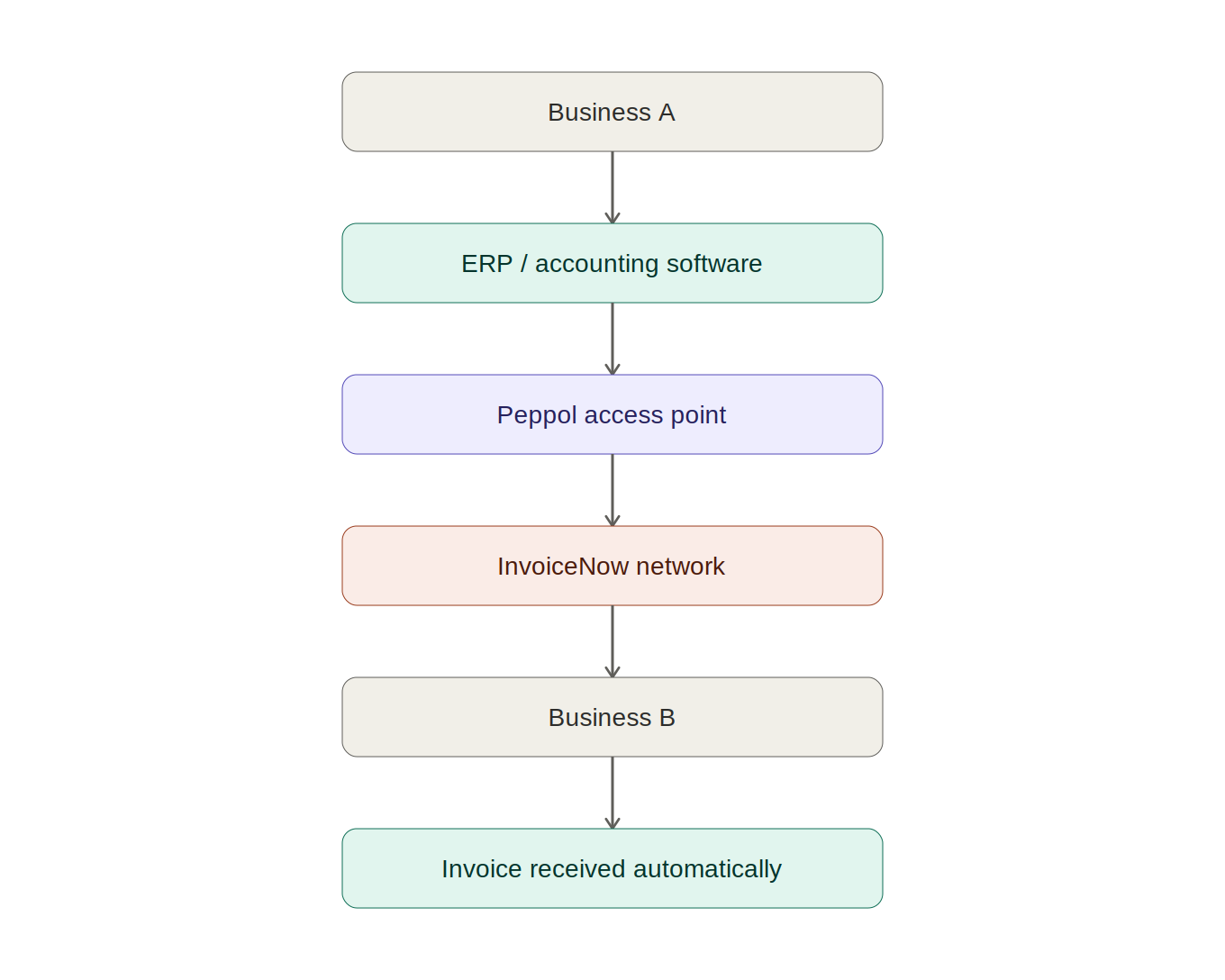
The process is more straightforward than most business owners expect. Once your business is set up on InvoiceNow, sending an invoice looks something like this:
Here’s what happens at each stage:
Business A creates an invoice inside their accounting or ERP software, the same way they normally would — no extra steps, no separate portal to log into.
The software formats the invoice into the structured data format required by Peppol, without any manual work from the user.
A Peppol Access Point sends the invoice onto the network. Think of an Access Point as a secure gateway; every business connected to InvoiceNow goes through one, usually built into their accounting or ERP software.
The InvoiceNow network routes the invoice to the correct recipient based on their registered Peppol identifier, similar to how an email is routed to the right inbox based on an email address.
Business B receives the invoice directly inside their own accounting or ERP system — no email, no PDF, no manual entry required on their end either.
The invoice is recorded automatically, ready for approval, matching, or payment processing, often within seconds of being sent.
The entire exchange typically happens within moments, and because both ends are working with structured data rather than a document, there’s very little room for the invoice to get lost, misread, or mistyped along the way.
Manual invoicing might feel manageable when your business is small, but the cracks start to show as volume grows.
Duplicate data entry is one of the biggest hidden costs. Someone creates the invoice, and someone else on the receiving end re-enters it. That’s two opportunities for typos, two people spending time on the same task, and no guarantee the numbers match.
Invoice delays are common too. A PDF invoice can sit unopened in an inbox for days before anyone processes it, especially during busy periods or when the right person is on leave.
Payment delays follow naturally from invoice delays. If an invoice isn’t logged into the system promptly, it isn’t queued for payment promptly either — and that has a direct impact on cash flow for both sides of the transaction.
Then there are the everyday human errors: a wrong figure keyed in, an invoice sent to the wrong contact, a document that gets buried and simply forgotten. None of these mistakes are due to carelessness; they’re the natural result of a process that still depends heavily on manual handling.
InvoiceNow addresses these issues at the source by removing the manual re-entry step entirely. For businesses serious about digital transformation, it’s often one of the simplest, most measurable wins available.
Faster invoice delivery. Invoices move from your system to your customer’s system in near real time, rather than waiting in an email queue.
Reduced manual work. Your finance team spends less time on repetitive data entry and more time on tasks that actually need human judgement.
Fewer errors. Because invoice data moves directly between systems, there’s no re-typing involved, which removes one of the most common sources of billing mistakes.
Faster payment cycles. When invoices are processed the moment they arrive, approval and payment can happen sooner, shortening the overall cycle from invoice to payment.
Better cash flow. Faster payment cycles mean money moves through your business more predictably, which is especially valuable for SMEs managing tight working capital.
Improved productivity. Staff previously tied up with manual invoice handling can be redeployed to higher-value work, from vendor management to financial planning.
Secure invoice exchange. Invoices travel through accredited Access Points rather than open email, reducing exposure to invoice fraud and interception.
Environmentally friendly operations. Less paper, less printing, and fewer physical documents to store or shred — a small but meaningful step toward more sustainable operations.
PDF invoice | InvoiceNow e-invoice |
Usually sent through email | Sent through its network |
Contains information in a document | Contains structured data that a system can read |
May require manual data entry | Can flow directly into user’s accounting software |
Can be missed in an inbox | Delivered securely to the recipient’s connected system |
Details may be entered incorrectly | Reduces repeated typing and transcription errors |
Processing depends heavily on manual work | Supports faster and more automated processing |
InvoiceNow is relevant to almost any business that sends or receives invoices regularly, but a few groups stand to benefit the most.
SMEs often feel the impact of manual invoicing the hardest, since finance teams tend to be small and every hour spent on data entry is an hour not spent elsewhere.
Manufacturers and wholesalers dealing with high invoice volumes across many customers and suppliers can see a significant drop in processing time.
Retailers managing frequent transactions with multiple suppliers benefit from faster reconciliation and fewer mismatched records.
Service companies that bill clients on a recurring basis can automate a large part of their receivables process.
Construction firms, which often juggle invoices from subcontractors, suppliers, and vendors simultaneously, gain better visibility over what’s owed and when.
Professional services firms, including accounting and consulting practices, can use InvoiceNow both for their own billing and to support clients making the same transition.
Growing enterprises preparing to scale will find that manual invoicing processes simply don’t hold up once transaction volumes increase — InvoiceNow is built to scale with them.
Getting started is a structured process, and most businesses can be up and running faster than they expect.
Choose an InvoiceNow-ready solution. Your accounting or ERP software needs to support InvoiceNow, either natively or through an accredited Access Point.
Register on the Peppol network. This gives your business a unique identifier so invoices can be routed to and from you correctly.
Set up the software. Your provider will help configure your invoicing settings so InvoiceNow becomes part of your normal workflow, not a separate system to manage.
Test the connection. Before going live, it’s worth sending a test invoice to confirm everything is set up correctly on both ends.
Train your team. Since the invoice creation process barely changes, training is usually light — mostly a matter of showing staff where InvoiceNow status appears in the software they already use.
Send your first InvoiceNow invoice. From here, it becomes part of your everyday invoicing routine.
Adaptive BizApp is an InvoiceNow-ready ERP solution built for Singapore businesses that want their invoicing to work alongside the rest of their operations, not separately from it.
Rather than treating InvoiceNow as a standalone add-on, Adaptive BizApp integrates it directly with accounting, inventory, purchasing, sales, CRM, and finance in one platform. That means an invoice generated through InvoiceNow reflects your actual stock levels, customer records, and financial data automatically, without someone having to reconcile it manually afterwards.
For businesses already managing multiple disconnected tools, this kind of integration tends to matter more in practice than any single feature. It’s less about having InvoiceNow as a checkbox and more about how naturally it fits into the way your business already runs.
InvoiceNow is changing how Singapore businesses handle one of their most repetitive, error-prone tasks: invoicing. By moving invoice data directly between systems instead of relying on PDFs, emails, and manual entry, businesses can process invoices faster, reduce costly mistakes, and get paid sooner.
With GST InvoiceNow requirements being phased in for GST-registered businesses through 2031, now is a practical time to explore InvoiceNow as part of your broader digital transformation plans, rather than waiting until it becomes unavoidable.
If you’re evaluating options, Adaptive BizApp is an InvoiceNow-ready ERP solution that brings invoicing together with accounting, inventory, purchasing, sales, CRM, and finance — helping your business manage the shift without adding another disconnected tool to the mix.
Manage finance,HRMS, inventory, sales & operations in one powerful platform to improve efficiency and accelerate business growth.
Built to support modern businesses with smart, scalable solutions. We simplify daily operations and enable teams to work faster, smarter, and more efficiently.
© 2026 Adaptive Cloud Systems Pte. Ltd. All Rights Reserved.