If you’re running a small or mid-sized business in Singapore, chances are your finance, inventory, sales and customer data don’t all live in one place. Maybe accounting is in one software, stock is tracked on a spreadsheet someone updates “when they get to it,” and customer details are scattered across emails and a CRM half the team doesn’t log into. It works, sort of — until an order gets fulfilled from stock that isn’t there, or the monthly numbers take two days to pull together instead of two hours.
That’s the gap ERP software is meant to close: one system for the operational side of the business, instead of five that don’t talk to each other.
This guide isn’t a generic “here are 10 ERPs, good luck” list. It’s built specifically around SME needs — five platforms, what each actually does well, roughly what they cost, and which one is genuinely the right fit depending on the size and shape of your business.
Most SMEs don’t set out to run their operations across five disconnected tools — it just happens gradually. Accounting software gets set up first. Then inventory gets tracked in Excel because the accounting tool doesn’t handle stock well. Then a CRM gets bolted on for sales. None of it was a bad decision at the time, but a few years in, nobody has a single clear picture of the business without pulling numbers from three places and hoping they match.
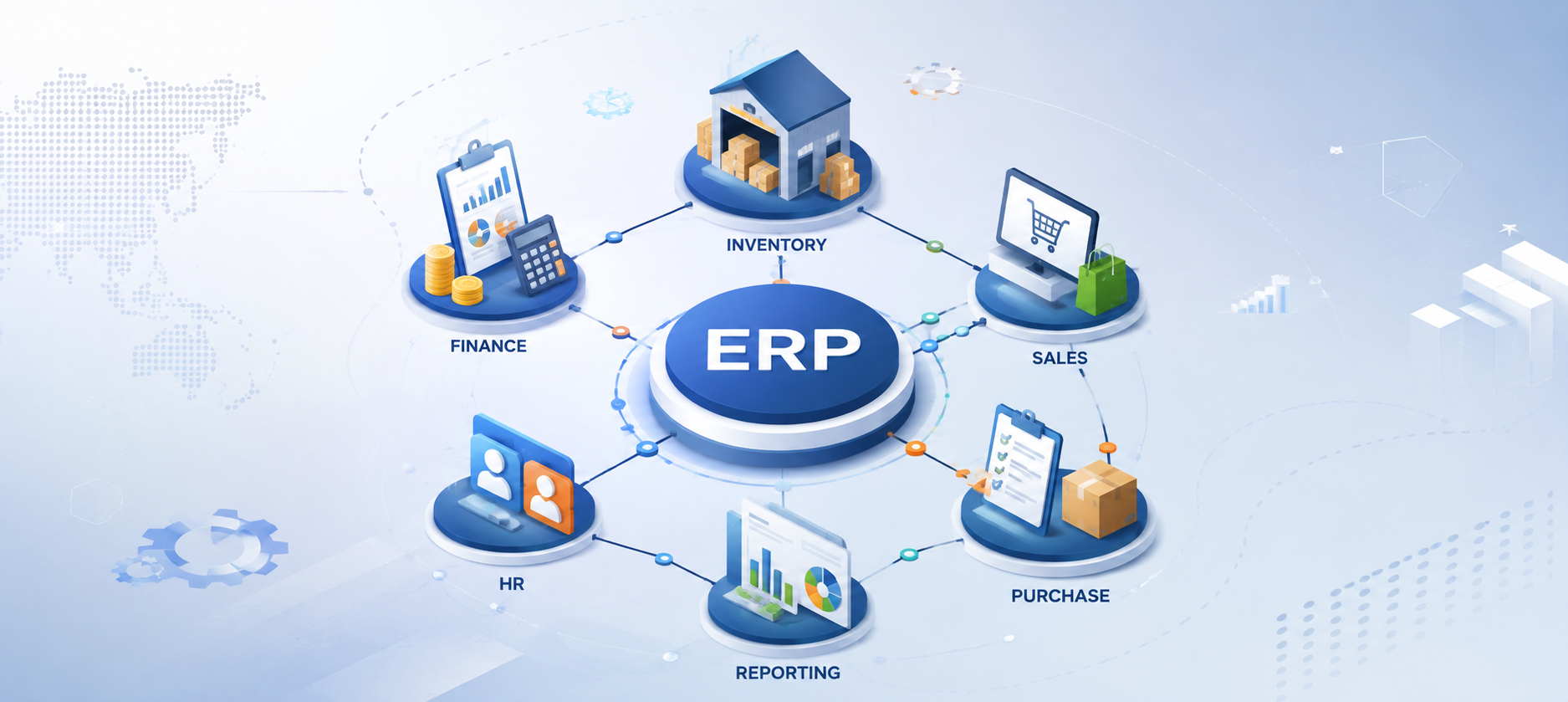
That’s usually when ERP software for SMEs starts looking less like a nice-to-have and more like something that pays for itself. A decent cloud ERP for SMEs centralises finance, inventory, purchasing, sales and customer data, so a stock update or a paid invoice reflects everywhere it needs to, immediately, without someone re-entering it by hand. For a small team, that’s not just convenience — it’s hours back every week that would otherwise go into reconciling numbers that shouldn’t need reconciling.
Adaptive BizApp is a cloud ERP platform built with Singapore SMEs specifically in mind, rather than a trimmed-down version of an enterprise system. That distinction matters in practice — it means GST-compliant accounting, local reporting formats, and an implementation process designed to get a small team running in a matter of weeks, not months.
The accounting and finance module covers general ledger, payables, receivables and financial reporting in one place, and inventory and warehouse management gives real-time visibility across multiple locations, so stock counts reflect what’s actually on the shelf rather than what a spreadsheet said last week.
On the commercial side, customer and sales management and CRM sit in the same system as purchasing and service management — meaning sales, order fulfilment and after-sales support all pull from the same customer records instead of three separate ones that drift out of sync over time. Reporting and analytics are built for everyday operational use, not as a bolt-on BI product you need a data analyst to interpret.
What consistently makes Adaptive BizApp a practical pick for SMEs is the balance it strikes: enough module depth to run finance, operations and sales properly, without needing dedicated IT staff to keep it running. And because it’s cloud-based and modular, the platform scales as the business grows — new users or modules get added when needed, rather than forcing a full re-platform down the line.
NetSuite offers broad functionality across financials, inventory and CRM, and it’s a common choice for businesses with more complex operations or plans for rapid scaling. The customisation and reporting depth are genuinely strong, but that comes with a more structured onboarding process, and many businesses bring in a partner to configure it properly rather than doing it in-house. Pricing is available upon request and scoped to company size. For a smaller SME, it’s worth weighing whether that level of customisation is actually needed yet, or whether it adds complexity ahead of when it’s useful.
Business Central’s biggest advantage for many SMEs is familiarity — it integrates naturally with Excel, Outlook and the rest of Microsoft 365, which shortens the learning curve for teams already using those tools. It covers core finance, inventory and sales, and reporting benefits from Microsoft’s existing Power BI ecosystem. Some of its deeper features are better suited to medium or larger organisations, though, and the per-user, per-month licensing is worth mapping against your actual headcount before assuming it’s the more economical option.
Odoo takes a modular approach — businesses pick individual apps (accounting, inventory, CRM, and so on) rather than committing to one fixed package, which appeals to SMEs that want to start small and add functionality as they grow. The trade-off is that deeper customisation typically requires developer involvement, and total cost can shift depending on how many modules and integrations get added over time. Businesses should evaluate whether they have the internal technical resources to manage that flexibility, or whether it becomes an ongoing dependency.
SAP Business One is aimed at small and mid-sized businesses wanting SAP’s enterprise-grade financial and inventory tools without the full scale of SAP’s larger suite. It covers accounting, inventory and a basic CRM layer, and is typically implemented through regional SAP partners. Additional setup may be required depending on industry-specific needs. Pricing isn’t publicly listed and is generally quoted per deployment — better suited to SMEs planning for medium-term growth than those needing something lightweight from day one.
Start with what’s actually costing you time right now, not the feature you might need in three years. If inventory and accounting never quite agree, prioritise a platform where those two modules are tightly integrated out of the box. If your team is small and doesn’t have technical support in-house, weigh ease of implementation and day-to-day usability as heavily as functionality — a system that takes six months to set up isn’t solving your problem, it’s postponing it.
It’s also worth checking whether the platform supports Singapore-specific requirements like GST reporting, and getting clarity on whether pricing is per-user, per-module, or usage-based before comparing quotes, since that structure affects how costs grow alongside your team. For broader support around digitalisation and funding schemes for Singapore SMEs, Enterprise Singapore and IMDA Singapore are useful starting points.
The right ERP isn’t necessarily the biggest or most feature-packed one — it’s the one that fits how your business actually operates today, with enough room to grow without needing to switch systems in two years. NetSuite and SAP Business One offer real depth for SMEs planning rapid or medium-term growth, while Odoo suits businesses that want to build up functionality module by module. For Singapore SMEs looking for something that covers accounting, inventory, CRM, purchasing and service management in one place, without a drawn-out implementation, Adaptive BizApp is a practical, scalable option worth putting on your shortlist.
If you’re comparing ERP options for your business, Get a Free ERP Consultation — it’s a lot more useful to talk through which modules actually fit your operations than to guess from a comparison table.
Manage finance,HRMS, inventory, sales & operations in one powerful platform to improve efficiency and accelerate business growth.
Built to support modern businesses with smart, scalable solutions. We simplify daily operations and enable teams to work faster, smarter, and more efficiently.
© 2026 Adaptive Cloud Systems Pte. Ltd. All Rights Reserved.