ERP vs Accounting Software: Which Is Better for Singapore SMEs?
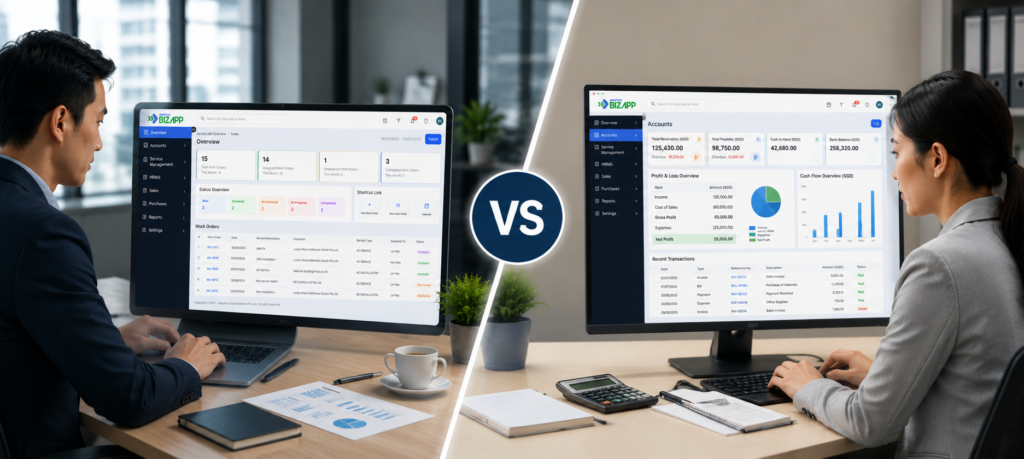
There’s a point in every growing Singapore SME’s life where accounting software stops feeling like enough. Maybe the inventory numbers don’t match what finance is seeing, or maybe someone’s spending half their week manually shuffling data between tools that were never meant to talk to each other. That’s usually when the ERP vs accounting software question shows up — and honestly, it’s less about which one’s “better” and more about which one actually fits the size and complexity the business has grown into.
Here’s a straight look at the real difference between the two, when accounting software is still the right call, and when it’s time to think about ERP instead (for a wider view of where Singapore’s SME digitalisation is heading, ACRA and Enterprise Singapore are both worth a look).
What Accounting Software Is Actually Good At
Accounting software does one job, and it does it well: managing the financial side of the business. Invoicing, expense tracking, bank reconciliation, tax filing, basic reporting — that’s the wheelhouse. For a small Singapore SME with fairly simple operations — not much inventory, one location, a small team — accounting software alone can genuinely cover what’s needed without introducing complexity the business doesn’t have a use for yet.
The cracks start showing as the business grows, though. Accounting software generally doesn’t stretch into inventory, procurement, CRM, or HR, so a business running all of those separately usually ends up right back where this conversation started: juggling disconnected tools and typing the same numbers in twice.
What ERP Does That Accounting Software Just Can’t
ERP takes a different approach entirely — instead of treating accounting as its own island, it pulls finance, inventory, procurement, sales, CRM, and HR into one platform. That’s really the heart of the ERP vs accounting software difference: accounting software manages the books, ERP manages the business those books are describing. Run ERP and you get real-time visibility across stock levels, purchase orders, the sales pipeline, and the finances all at once, rather than stitching that picture together from separate systems every time someone needs an answer.
It also scales differently — accounting software tends to hit a ceiling once you’re dealing with multiple warehouses or departments that genuinely need to share live data, while ERP is built with exactly that kind of growth in mind. If you’ve read our piece on how Cloud ERP helps Singapore SMEs grow faster, this is the same shift — ERP swaps out a pile of separate tools for one connected system.
So Which One Actually Fits Your Business?
Accounting software is usually still the right call if your SME has simple operations, little to no physical inventory, one location, and financial needs that don’t go much beyond invoicing and basic reporting. ERP starts making more sense once you’re managing inventory across multiple sites, running procurement alongside sales and finance, watching SKU counts climb, or noticing departments doing the same work twice because their systems don’t talk.
A useful gut-check: add up what you’re currently paying for separate accounting, inventory, and procurement tools, plus the manual hours spent connecting them — if that total’s creeping close to what one ERP platform would cost, that’s usually your answer.
Signs You’ve Outgrown Accounting Software
A few things tend to show up right before a business finally makes the jump: inventory and financial figures stop matching because they live in different systems, staff are spending real hours manually moving data between accounting software and everything else, multiple warehouses make stock tracking unreliable, procurement and sales are working off different numbers, and growth is starting to outpace what accounting software was ever meant to handle.
None of that means accounting software was the wrong choice to begin with — it usually just means the business has grown past what it was built to do.
Frequently Asked Questions (FAQs)
1. What’s the actual difference between ERP and accounting software?
Accounting software handles financial tasks like invoicing and reconciliation. ERP connects finance with inventory, procurement, sales, and HR, so the whole business runs off one system.
2. Can you start with accounting software and move to ERP later?
Definitely — it’s a common path. Plenty of Singapore SMEs start there and upgrade once operations get too complex for accounting software to keep up with.
3. Is ERP more expensive than accounting software?
Usually, upfront, yes. But once you’re running several disconnected tools alongside accounting software, ERP can end up cheaper overall by replacing all of them with one system.
Conclusion
The ERP vs accounting software decision isn’t really about which one’s objectively better — it’s about matching the tool to how complicated your operations have actually gotten.
AdaptiveBizApp brings finance, inventory, procurement, CRM, and HR into one ERP platform, giving Singapore SMEs a natural next step once accounting software alone stops cutting it. Worth a read too: our piece on how ERP software improves business efficiency for Singapore SMEs, and our guide to the best inventory management software for Singapore SMEs, both on the AdaptiveBizApp blog.
Book a free demo with AdaptiveBizApp and see how ERP stacks up against your current accounting software setup. Book a Free Demo Today:
www.adaptivebizapp.com